


Last updated: July 16, 2026
If you’re sourcing custom mold LED motif lights for the 2026 Christmas season, the short answer is this: a supplier who can manage the full custom tooling process for you — rather than only reselling off-the-shelf shapes — is what lets you turn a drawing into a Santa, snowman, or reindeer motif light that nobody else in your market is selling. At Yize Lights, we manage that process end to end: your design goes through mold development with our dedicated tooling partner, then sampling, LED assembly, and CE/UL/RoHS-compliant mass production run on our own factory floor in Zhejiang, China, before it ships to your warehouse in North America. The catch is timing — Christmas is only about 4–5 months away from mid-July, and the full custom-mold-to-doorstep cycle typically takes 12–15 weeks. This guide walks through exactly how that process works, what “RoHS compliant” actually means for your compliance paperwork, and the week-by-week timeline you need to hit shelves before the holiday rush.
What Are LED Motif Lights, and Why Does “Custom Mold” Matter?
Motif lights are decorative LED fixtures built around a solid shape — a star, a snowflake, a reindeer, a snowman — rather than a plain string of bulbs. The shape itself is usually a clear or frosted PVC/acrylic outline (sometimes rope-light wrapped, sometimes flat acrylic panel) with LEDs embedded or threaded along the frame, so the whole figure glows as one recognizable silhouette. Christmas motif lights are the single biggest use case for this format — think lit-up Santas and snowmen on a front lawn, or a giant star mounted above a storefront — but the same construction method also covers Halloween figures, corporate logos, and seasonal retail displays.
The reason “custom mold” matters commercially is simple: stock motif shapes are the least defensible product in the LED lighting category. If you sell the exact same snowman shape every other importer buys from a catalog, your only lever is price. A supplier who can manage new tooling built from your own drawing — a proprietary character, a licensed shape, a brand logo, a size nobody else stocks — gives you a SKU your competitors literally cannot source elsewhere. That is the core value proposition behind a custom mold LED motif lights factory relationship, and it’s why serious importers increasingly ask “can you tool a new shape” before they ask “what’s your unit price.”
Why Custom Tooling Matters for Christmas Motif Lights Specifically
Christmas motif lights carry two pressures that other categories don’t: a hard seasonal deadline (nobody buys a lit-up Santa in January) and intense retail differentiation pressure (big-box retailers and DTC brands alike want a “signature” piece for their holiday line, not a shape every competitor also carries). That combination is exactly why custom tooling pays for itself in this category faster than almost any other decorative lighting product.
A retailer launching a private-label outdoor Christmas collection, for example, doesn’t want the same three-point star or generic reindeer that’s been sold since 2019. They want a shape tied to their own brand character, a size that fits their specific packaging, or a design their in-house team sketched. Custom mold tooling is what makes that possible — and because the tooling itself is a one-time cost that’s amortized across the full production run, it becomes cost-competitive at meaningful volumes (see MOQ guidance in the FAQ below).
Inside Our Factory: From Molded Shape to Finished Motif Light
Yize Lights operates a 4,000 m² factory in Linhai, Zhejiang, with 50+ production staff and an annual capacity of 10M+ sets across our full LED decorative lighting range. A custom motif light moves through three connected stages before it’s ready to ship:
- Tooling & forming — the motif shape (acrylic panel, PVC rope-light frame, or 3D acrylic figure) is produced using injection molding or CNC-cut tooling built to the approved drawing. New tooling is developed and cut through our dedicated mold-making partner, working directly from the design our team approves with you — we manage this step for you end to end, so you deal with one point of contact, not a separate mold shop.
- LED wiring & assembly — once the molded shapes arrive at our factory, LED modules or rope-light strings are threaded, soldered, and secured into the formed shape by hand, then connected to the power lead and controller (where applicable — flashing/twinkle/steady modes).
- Electrical testing & QC — every unit runs through a 100% electrical safety test (continuity, insulation, voltage) before packing, with a documented pre-shipment inspection report for the batch.
Below is what LED wiring and assembly looks like once the molded motif shapes reach our production floor:

Our team works from your drawing or reference photo, coordinates a mold design proof with our tooling partner for your review, and only proceeds to cut the production tool once you’ve signed off — so there’s no surprise cost if a revision is needed before mass production starts. Before committing to a full custom mold order, always confirm in writing exactly who retains ownership of the finished mold once tooling is paid for — this determines whether you can move that specific tooling to a different supplier later, and it’s a five-minute clause worth getting in writing rather than assuming.
Material Options: Acrylic Panels vs. Rope-Light Frames
Not every custom motif light is built the same way, and the material choice affects both tooling cost and the finished look:
- Flat acrylic panel — the shape is CNC-cut or molded from a solid acrylic sheet with LEDs embedded behind or within the panel, giving a bright, even “glow” silhouette. Cheaper to tool for simple 2D shapes, and the most common choice for large lawn displays like a giant star or a flat Santa cutout.
- Rope-light wireframe — the shape is built from a bent metal or rigid PVC frame wrapped in LED rope light, producing a more “sketched,” linear look. This construction handles complex 3D curves (a full-bodied reindeer, a looping ribbon shape) better than a flat panel and is generally the choice for higher-detail figures.
- 3D acrylic figure — multiple molded acrylic pieces are assembled into a standing, dimensional figure (as opposed to a flat 2D outline). Highest tooling cost and longest lead time of the three, but the strongest shelf-appeal for premium retail lines.
Tell your supplier which look you’re going for — “flat lawn stake” vs “dimensional standing figure” — as early as the drawing submission stage, since it changes both the mold design and the 15–25 day tooling estimate above.
Our Custom Mold Process, Step by Step
Here is the answer to the question most importers actually ask first — “how does this actually work, end to end”:
- Drawing or reference submission — you send a sketch, vector file, or reference photo of the shape you want.
- Design proof & DFM feedback — our team returns a design proof plus manufacturing feedback (e.g., wall thickness, LED spacing, structural support points) within 3–5 business days.
- Mold/tooling build — once approved, tooling is cut by our mold-making partner against the signed-off design: 10–15 days for simple 2D acrylic panel shapes, 18–25 days for more complex 3D or multi-part figures.
- First sample production — 3–5 days to mold and wire the first physical sample off the new tool.
- Sample review & sign-off — sample ships to you (typically 3–5 days by express courier); you inspect shape, brightness, color temperature, and mechanical fit, then approve or request a tooling adjustment.
- Mass production — 25–35 days for the bulk order, run against the approved sample as the production standard.
- Pre-shipment QC & packing — 3–5 days, overlapping with the end of production.
Add it up and a new custom mold realistically adds 3–4 weeks up front (tooling + first sample) compared with ordering an existing stock shape — which is exactly why the timeline math in the next section matters so much for a hard deadline like Christmas.
Are Our LED Motif Lights RoHS Compliant? What Importers Need to Know
Yes — Yize’s LED motif and Christmas lights are produced to meet RoHS (Restriction of Hazardous Substances) requirements, alongside CE, UL, BSCI, LVD and EMC certification/compliance, depending on the target market and product line. But “RoHS compliant” gets confused with CE and UL often enough that it’s worth spelling out exactly what each one actually covers, because customs brokers and retail compliance teams will ask about all three separately:
| Certification | What it actually covers | Where it’s required | Who checks it |
|---|---|---|---|
| RoHS | Restricts hazardous substances (lead, mercury, cadmium, certain flame retardants) in the materials and components | EU (mandatory), increasingly referenced by US retailers as a quality/safety proxy | EU market surveillance authorities; large US retailers often require it contractually even though the US has no federal RoHS law |
| CE | Self-declared conformity with EU safety directives (LVD for voltage safety, EMC for electromagnetic interference) — a market-access mark, not a lab-audited certificate | European Economic Area | EU customs and market surveillance |
| UL | Third-party lab-tested product safety certification against US/Canada safety standards | US and Canada retail (Home Depot, Amazon, Walmart, Costco routinely require UL listing) | Underwriters Laboratories or an accredited UL-recognized lab |
The practical takeaway for a North American importer: RoHS tells you the materials are clean, UL tells you the product itself passed a safety test recognized by US retailers and customs. If your motif lights are headed to big-box or major e-commerce retail in the US/Canada, ask specifically for UL listing documentation, not just a RoHS statement — the two are not interchangeable, and a retailer’s compliance department will ask for the one they actually require. If you’re selling into the EU instead, RoHS plus a CE Declaration of Conformity is your baseline.
Ask your supplier for the actual test report and certificate numbers (not just a logo on a product photo) before you commit to a bulk order — this is a five-minute email that avoids a customs hold later.
The Full Timeline: From Custom Mold to Your Warehouse Before Christmas
This is the section most buyers actually need, so let’s be direct: if you’re reading this in mid-July, you have roughly 4–5 months until Christmas Day — and the realistic custom-mold-to-warehouse cycle eats up most of that window. Here’s the full breakdown for a new custom mold order shipping to North America:
| Stage | Duration | Running total |
|---|---|---|
| Design proof & tooling build | 15–25 days | Day 15–25 |
| First sample + review/approval | 8–12 days | Day 23–37 |
| Mass production (bulk order) | 25–35 days | Day 48–72 |
| Pre-shipment QC & packing | 3–5 days | Day 51–77 |
| Inland trucking to Ningbo/Shanghai port | 1–3 days | Day 52–80 |
| Ocean freight — US West Coast (LA/Long Beach) | 16–22 days | Day 68–102 |
| Ocean freight — US East Coast (NY/Savannah, via transshipment) | 30–38 days | Day 82–118 |
| US customs clearance + last-mile trucking | 3–7 days | Day 71–109 (West) / Day 85–125 (East) |
In plain terms: a new custom mold shipped to the US West Coast takes roughly 10–16 weeks door-to-door; East Coast destinations add another 2–3 weeks on top of that. If today is mid-July and Christmas is in early-to-mid December, that leaves only a thin buffer once you account for retailer receiving windows, in-store merchandising setup, and DTC fulfillment prep — most experienced importers aim to have Christmas motif lights landed and available for sale by early-to-mid November, which means placing a new custom mold order no later than early August for West Coast destinations, and mid-to-late July for East Coast destinations.
If your shape is already tooled from a previous season (no new mold needed), you can skip straight to the mass production step and shave 3–4 weeks off the total — which is worth knowing if you’re deciding between “custom this year” and “custom next year, reorder existing tooling this year.”
Here’s what that finished, wired, and tested product looks like once it reaches a customer’s front yard at the end of this whole chain:

Shipping to North America: Port, Incoterms & Customs Basics
Yize ships primarily via Ningbo and Shanghai ports, the two major container gateways serving Zhejiang-based factories. Two Incoterms cover the vast majority of orders:
- FOB (Free on Board) — we handle export customs clearance and loading onto the vessel at the Chinese port; you (or your freight forwarder) arrange and pay for ocean freight, import customs, and inland delivery from there. This is the most common term for importers who already have a freight forwarder relationship.
- EXW (Ex Works) — you (or your forwarder) take responsibility from our factory gate onward, including export documentation. Slightly cheaper on paper, but only worth it if your forwarder is experienced with China export procedures.
A cargo vessel loaded and departing for North America looks like this — this is the stage that starts the 16–38 day ocean transit window from the timeline table above:

For customs clearance on the US side, three documents matter most: the commercial invoice and packing list (matching your PO exactly), the Bill of Lading, and — if UL listing is required by your retail buyer — the UL test report and certificate number, which US Customs and Border Protection or your customs broker may request during an exam. Filing your Importer Security Filing (ISF) at least 24 hours before the vessel departs China is a US-specific requirement that catches first-time importers off guard; your freight forwarder typically handles this, but confirm it’s included in their scope before you assume it is.
Frequently Asked Questions
What’s the minimum order quantity (MOQ) for a custom mold LED motif light?
MOQs for a brand-new custom mold typically start around 300–500 pieces per SKU, since the tooling cost needs to be spread across a meaningful production run to stay cost-competitive. Smaller pilot runs are sometimes possible at a higher unit price to cover a larger share of the tooling cost — ask your sales contact for a quote at your specific target volume.
How much does opening a new mold cost, and do I own it?
Tooling cost depends on the shape’s size and complexity — a flat 2D acrylic panel mold costs meaningfully less than a multi-part 3D figure. Always get mold ownership terms in writing: some factories transfer the physical mold (or usage rights) to the customer once tooling cost is paid in full, which matters if you ever want to move production to a different supplier later.
Can I get a sample before committing to a full custom mold order?
Yes. The process above always includes a first-sample review step before mass production starts — you approve shape, LED color/brightness, and mechanical fit before your order goes into the full production run.
Do I need both RoHS and UL certification for the US market?
Not always, but if you’re selling into a major retailer (Home Depot, Walmart, Amazon, Costco), assume UL listing will be required regardless of RoHS status — RoHS is about material safety, UL is about electrical product safety, and US retail compliance teams typically ask for UL specifically. Confirm with your specific buyer’s compliance requirements before finalizing.
How late can I place an order and still receive it before Christmas?
Based on the timeline above, new custom mold orders should be placed no later than early August for West Coast US delivery or mid-to-late July for East Coast delivery, to land with a comfortable buffer before the holiday retail window. Reorders of an existing (already-tooled) design have roughly 3–4 more weeks of flexibility since the tooling step is skipped.
What materials are your motif lights made from, and are they rated for outdoor use?
Depending on the shape and construction method (see the material comparison above), motif lights are built from acrylic panels, PVC-jacketed rope light, or a combination of both, with weatherproof (IP44/IP65-rated, depending on the specific product) connectors and power supplies for outdoor placement. Always confirm the IP rating for your specific SKU if the display will sit outdoors through rain or snow for the full holiday season.
Can I customize just the color or size without paying for a new mold?
Yes — if you’re working from one of our existing tooled shapes, changing the LED color, adding a twinkle/steady mode, or adjusting the overall length (for rope-light designs) usually doesn’t require new tooling at all, which keeps both cost and lead time close to a standard reorder rather than a full custom mold timeline.
Ready to Start Your Custom Motif Lights Order?
Whether you’re tooling a brand-new character for a private-label Christmas line or need RoHS and UL documentation to clear a retail compliance review, the earlier you start the conversation, the more of the calendar you keep as buffer instead of risk. Browse our full Wholesale LED Motif & Shape Lights range for existing tooled shapes ready for faster reorder, check our CE, UL & RoHS Certified LED Lights documentation, or request a quote with your drawing or reference photo and target ship date — our team will map out your specific custom mold timeline within 24 hours.
Recommended Articles
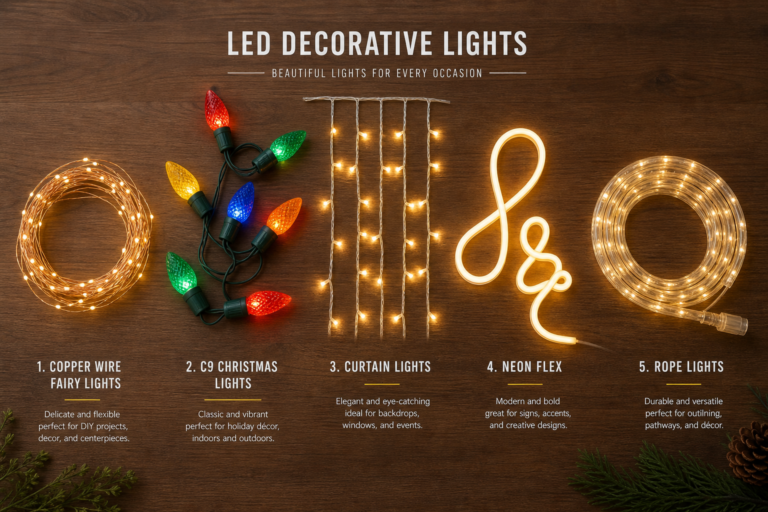
Different Types of LED Decorative Lights Explained
Answer-First (Executive Summary): Understanding the different types of LED decorative lights is key to sourcing the right product for your...
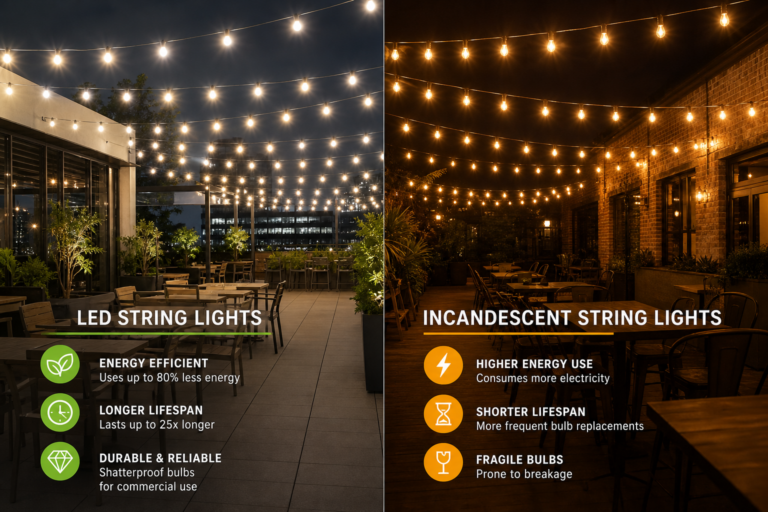
LED vs. Incandescent String Lights: Why Commercial Buyers Choose LED
Answer-First (Executive Summary): Commercial buyers overwhelmingly choose LED string lights over traditional incandescent bulbs due to massive energy savings (up...
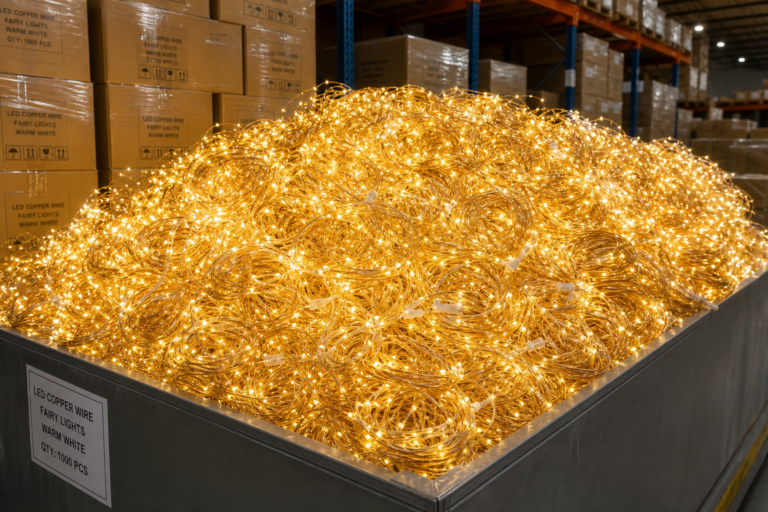
Wholesale Fairy Lights: What to Look for When Sourcing in Bulk
Answer-First (Executive Summary): When sourcing wholesale fairy lights (copper wire lights), buyers must evaluate wire purity, bulb spacing, and power...